


RKC’s new Breeding for Health Framework published alongside new report highlighting the key issues and potential threats to pedigree dog breeds
- · The BFHF sets out the way the RKC is going to support pedigree dog breeding to safeguard the future of pedigree dogs
- · A new future for dog breeding” report published, authored by Dr Alison Skipper
- · The BFHF is the culmination of more than a decade of work and pulls together several key projects undertaken throughout 2025
- · The RKC will deliver three significant projects in 2026 for breeders, in close collaboration with both vets and breeders, following extensive work throughout 2025
London, 13 January 2026: The Royal Kennel Club, the UK’s oldest and most respected dog organisation, has today launched its Breeding For Health Framework (BFHF), based on a report, authored by Dr Alison Skipper. The report underpins the Royal Kennel Club’s BFHF, which will act as the roadmap for the future of pedigree dogs and is the result of over a decade’s work in this field, culminating in a number of key projects undertaken over the course of last year.
The BFHF comes at a time when the world has dramatically changed, and the dog breeding landscape is facing unprecedented challenges. The RKC recognises the need to do more to support the pedigree dog breeders, this is exactly what this work intends to achieve.
The framework builds on many years of work, reviewing over 4,000 scientific publications on pedigree dog health and follows on from our Breed Health and Conservation plans. Most importantly, the RKC identified the primary issues and, having listened to the community, commissioned a report in early 2025 to dictate how best to support pedigree dog health.
The framework is the result of this report, authored by Dr Alison Skipper, which includes a full review of all 222 Breed Health and Conservation plans in addition to close collaboration with numerous stakeholders including breeders, breed health co-ordinators, veterinarians and subject matter experts.
Central to the report, which has been published today (here) alongside a shorter, summarised version, is the framework which categorises the key issues for pedigree dogs into nine areas to be addressed.
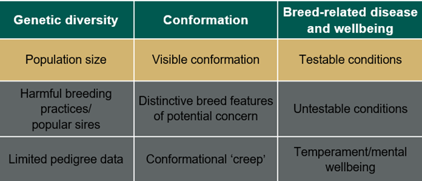
In 2026, the RKC has committed to deliver, in close collaboration with both vets and breeders, a key project to tackle each of the key areas; Genetic diversity, Conformation and Breed-Related disease.
Genetic Diversity: Small Populations Working Group - The BFHF has identified, based on scientific evidence, groupings of breeds which we will prioritise. We have therefore already invited representatives from over 100 breeds to form a working group to build the plan for their future.
Conformation: Nose-To-Tail Veterinary Assessment - Dogs need a healthy body shape, and breeders need a tool that has been scientifically backed and measures conformation to help them make informed choices. The BFHF will help us to deliver a nose-to-tail veterinary assessment by the end of this year.
Breed-Related Disease: Mandatory Health Testing Process - The BFHF builds on the existing health standard to determine when health testing should or shouldn’t be mandatory, based on the breed and type of test. The development of this process will begin in 2026.
This work, initiated in early 2025 and building on a decade of work in this field, ensures our findings and subsequent plan have been thoroughly researched, stress-tested and scientifically verified. However, recent external factors at the end of 2025, with regard to conformation in particular, mean this work is more vital than ever. Given the scientific review this work has been based on, we are confident that our unique solution we will be able to offer with our nose-to-tail veterinary assessment by the end of the year, will equip breeders to address the challenge with the support and backing of both the RKC and our veterinary community.
Charlotte McNamara, The Royal Kennel Club’s Head of Health and Breeding, says, “No organisation is beyond reproach, and we recognise our role in the challenges we now face when it comes to pedigree dogs. We are committed to playing a leading role in tackling these challenges with a solid plan which is being implemented in conjunction with both breeders and the veterinary sector. We are here to listen, and we know our success is dependent on a close relationship with our breeding community”.
Dr Alison Skipper, author of the “A New Future for Dog Breeding report”, says, “The Royal Kennel Club is uniquely positioned to lead improvements in canine health. Together we have developed a new, comprehensive Breeding for Health framework that builds on our current health tools and resources to better address concerns which cover all aspects of health. I firmly believe anyone should feel proud to buy a healthy pedigree puppy from a traceable, RKC-registered breeder who follows best health and welfare practice.
Ian Seath, Chairman of the Royal Kennel Club, says, “When we announced our new Royal prefix in November, we said that this strengthened our purpose to do more. The BFHF demonstrates how we are “At Their Service” and we are confident that this is a turning point for both the organisation and our community. Without this vital work, we must unfortunately acknowledge the reality that external factors could pose a real risk to some of our most loved breeds.”
Take read the full report, a summary version and find out more about the Royal Kennel Club’s canine health initiatives visit www.royalkennelclub.com or www.crufts.org.uk.